Showing posts with label Science. Show all posts

Sunday, April 7, 2013

Pet Show

To finish off our unit a local pet shop owner stopped by with some of his pet shop friends.


He taught us about different types of pets and how we can care for them.

He showed us the difference between a small pet and a large pet


Some of the teachers didn't mind the snakes and some left the show when they came out


He let us touch the pets and we discovered that the spikes on the back where soft and not sharp


and even hold them

He showed us a tarantula spider that the children wanted to keep in the box and the teachers were glad.  (Snakes yes, Spiders NO!)


Mrs. Torres enjoyed herself most of all.

What child does not like learning about pets?  If you're looking to bring in some pet shop learning fun.  You can find my Pet Shop theme lesson plan on Teachers Pay Teacher or Teachers Notebook.


Wednesday, February 13, 2013

Writing on Slime


Are you looking for new ways to get your kids excited about writing, well do I have the fix all for you.

You got it Slime!.

Slime Recipe
Ingredients:
·      Warm water
·      Elmer’s or White craft glue
·      Borax (you can find in most grocery stores and the laundry soap isle)
·      Green food coloring
·      2 bowls
Directions:
1.  Mix together 3/4 cup warm water and 1 cup glue  into a bowl.
2.  In the second bowl, mix 4 teaspoons borax and 1 1/3 cups warm water.
3.  Pour the contents of the first bowl into the second bowl and do not stir. Let the mixture sit for about one minute.

I made a double batch to give me enough slime for a table of 8 children.

Give each child a small amount of slime and some color markers.

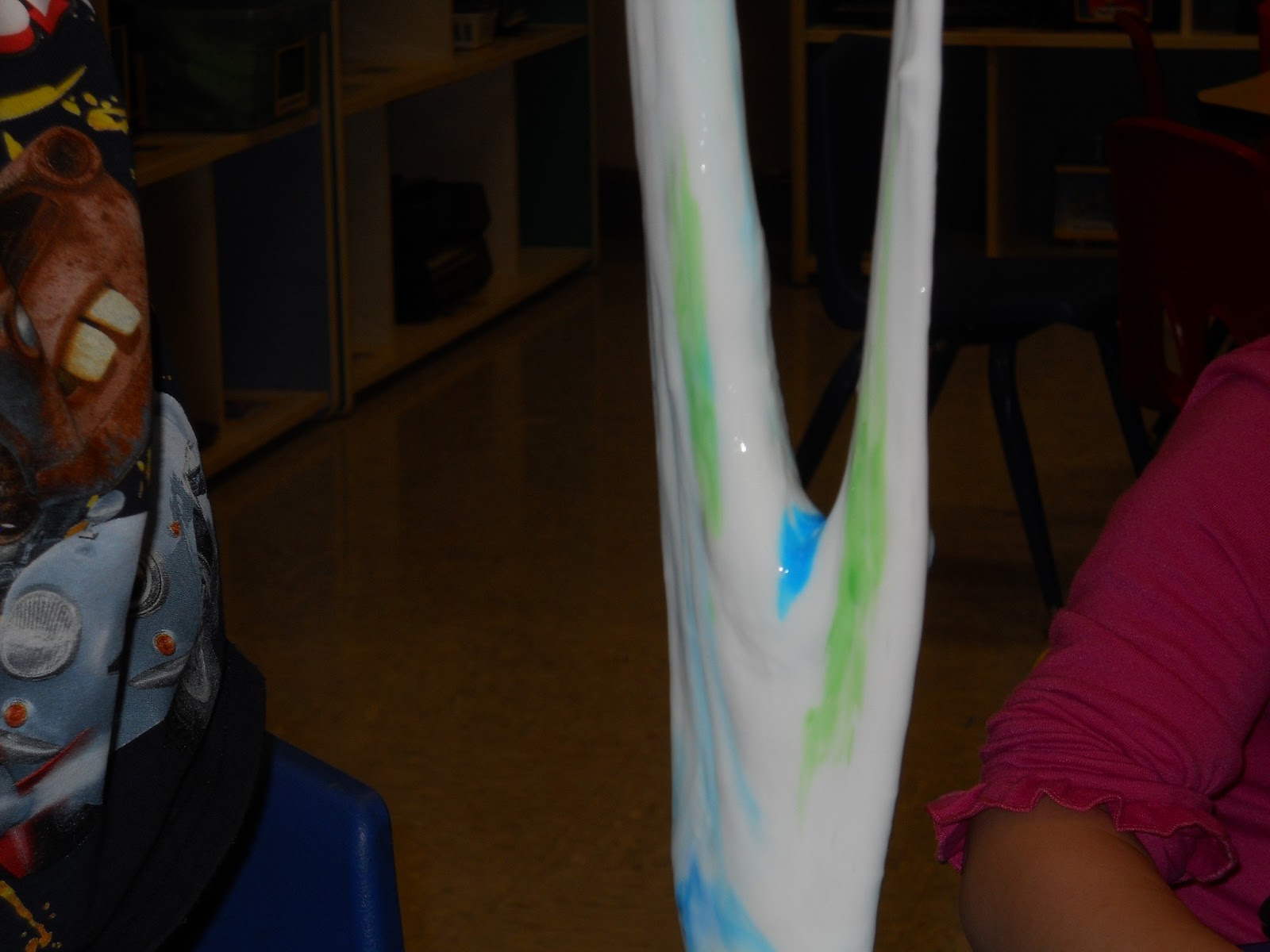
Children pat it until it is flat to write


 Write stretch and write again


 This project also turned into a great color mixing project.


Sunday, November 4, 2012

What will Happen?

We wanted to know if seeds in the pumpkin would grow and if Indian corn would grow.

First we asked the children to predict what will happen if we added dirt to the pumpkin and Indian corn.  We wrote down what all of the children said so that we can revisit it later.


Children took turns adding dirt to the inside of the pumpkin and also into a bowl that the corn would go in.


Next the children watered the dirt.


Now we are just waiting to see what will happen.  We will be taking pictures to record what is happening to the project.  Children will also be telling us what they see and their answers will be recorded.


Sunday, October 14, 2012

A Peek At Our Week

We have been very busy with pumpkin science projects like sink and float, what's inside a pumpkin and what will happen?   

What is inside a Pumpkin?


 What will happen?

After the children were done exploring what was inside the pumpkin we cut up the pumpkin and placed the pieces inside a glass jar.  What had the children predict what they thought would happen to the pumpkin inside the jar.

We will keep you post with pictures at what is happening to our pumpkin.


Pumpkin Art


 Pumpkin Letter Bingo

 Sound Sorting with Scarecrow


 Sammy Scarecrow pocket chart story


 Crow Art

Some of the crows are watching our science area from a tree.


 Scarecrows to scare the crows away


Tuesday, July 31, 2012

Exploration Trays

We could not go to the beach with the children since it is a long ride (3 1/2 hours) we brought what we could of the beach to them.  


We placed beach sand, small pieces of drift wood, shells and sea glass.  Each try also had a magnifying glass.

Thank you Inez for always being the bag lady where ever you go.  (she cannot go anywhere without picking up stuff bring to school)

Remember that you can vote once a day for the top 25 Teacher Mom bloggers.


Thursday, April 19, 2012

Water Wall

I have finally made one, I have been dreaming of making one of these for a long time and here it is.

 I need to make a few design changes like place items on both sides of the board so that more children can utilize it at the same time.

Back side picture

Now I need to make at least one more since it is such a huge hit and the weather is getting warm here, what better way to stay cool?

Here is what I used to make it

1 sheet of Plexiglas 2 X 3
1” PVC pipe
2 90 pipe fittings
4 T shape pipe fittings
20 nuts and bolts.
Zip ties to attach the Plexiglas to the PVC frame 

Original Idea came from Share & Remember   


Monday, February 20, 2012

Mixing Slime


Discovering the world around you!
Young children’s innate curiosity about investigating their world makes them natural scientists.
Young children are born scientists, whose boundless curiosity and developing skills give them the motivation and capability to investigate and better understand their world.
When we teach preschool children science we are teaching the skills children will need throughout their lives to think about a problem and to explore its possible answers.
Mixing Slime
Children will develop chemistry skills as they combine materials.

We have all provided pre-made slime, but wouldn’t it be more beneficial to let the children mix it themselves.  Understanding that combining the materials and watching the transformation is the most intriguing aspect of the early childhood sensory experience.
Provide the children with a large art tray.  On the tray have a small container for mixing, a cup with spoon and white glue.  Have a container of liquid starch on each tray along with different colors of liquid watercolors with droppers.  If you do not have liquid watercolors use food coloring.  


Friday, March 18, 2011

T is for Toad

On Fridays we feed the toads before leaving for the weekend.  Today we feed the toads crickets, the children estimated how many they thought each toad would eat.  As they watched them they counted and laughed, counted and laughed.  They had the best time watching them eat crickets.  One toad ate 7 crickets in 10 minute. 


Saturday, March 5, 2011

Science Discoveries

Discovering the world around you!


Young children’s innate curiosity about investigating their world makes them natural scientists.


Young children are born scientists, whose boundless curiosity and developing skills give them the motivation and capability to investigate and better understand their world.


To learn about science is to….


• Learn how to think
• The abilities to comprehend
• To Apply
• To Analyze
• To Synthesize
• To Evaluate


To learn about science is essential for higher-order of thinking and problem-solving skills. These skills are needed to form the foundation of all learning.


When we teach preschool children science we are teaching the skills children will need throughout their lives to think about a problem and to explore its possible answers.


When teaching science to preschoolers you are also incorporating Math, Literacy and Motor Skills.


As we teach children to “experience” science, remember that it’s an approach to learning and life.


These science activities are designed to be open-ended. Remember that hands on learning, is the most appropriate way for children to explore and learn about their world.

Color Rain/Color Mixing


Discovering Goop


Discovering Bones


Making Discovery Bottles


Rain Meter


Observing Snails


Observing Worms


Ice and Rock Salt Experiment


Exploring Bubbles


Environments which facilitate exploration, cultivate creativity, encourage wonder and problem solving, are environments that plant the seeds for a love of life long learning.

Our job is to connect the experiences to the concepts in a manner that allows the children to be actively involved in their explorations and discoveries about the world around them.

LinkWithin

Related Posts with Thumbnails